
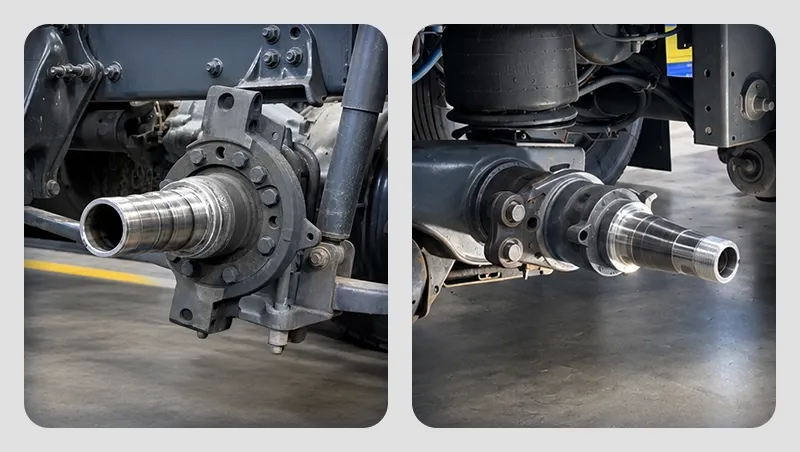
Choosing the correct replacement spindle requires matching its dimensions, bearing specifications, seal size, thread size, and axle rating to the OEM spindle. A worn or damaged spindle can cause grease leaks, hot hubs, wheel wobble, and uneven tire wear. Replace it if the bearing surfaces are scored or if it is bent, cracked, or out of spec.
Every wheel on a truck or trailer turns on a spindle, and when that part wears or fails, the problem shows up fast and can become a safety issue. Spindles aren’t one-size-fits-all because each vehicle has its own configuration.
In this blog, you will learn what spindles do on a truck or trailer, how to identify the right spindle, how to spot signs of wear, how to check spindle wear with Axle Spindle’s No-Go Gauge, and how to choose the correct replacement.
Truck and Trailer Axle Spindles Explained
A spindle is a short shaft at the end of an axle that supports the wheel hub and bearings. The spindle stays fixed while the hub and wheel rotate around it. It must be strong and precisely made to support the vehicle’s weight and keep the wheel properly aligned.
Where is the Spindle located?
The spindle is located at the end of the axle, at each wheel position. It is the shaft that extends from the axle tube or steering knuckle, and the wheel hub and bearings mount on it. It sits inside the wheel-end assembly, so you can’t see it until you remove the wheel, hub, and bearings.
- Trailer Axles: On a trailer, the spindle is a non-driven stub shaft attached to the end of the hollow axle tube, typically by welding or another approved method.
- Truck Drive Axles: On a full-floating truck drive axle, the spindle is a hollow extension of the stationary axle housing. The axle shaft passes through its center and delivers torque to the wheel hub, while the spindle supports the wheel-end load.
- Front-Steer Axles: On a front-steer axle, the spindle is integrated into a moving steering knuckle that swivels around a kingpin or ball joints, ensuring accurate steering under heavy loads.
What Other Components Work With the Spindle?
The spindle works as part of the wheel end. Each part below depends on the spindle being straight and within spec.
| Part | What It Does |
| Inner and outer wheel bearings | Support the hub and allow it to rotate smoothly around the spindle. |
| Wheel seal | Keeps lubricant in and keeps dirt and moisture out. |
| Wheel hub | Holds the wheel and rotates around the spindle. |
| Spindle nut and washer | Secures the bearings and maintains proper bearing adjustment. |
| Spindle nut locking device | Helps prevent the spindle nut from loosening during operation. |
| Lubricant (grease or oil) | Reduces friction and heat in the wheel bearings. |
| Brake spider | Provides a mounting point for brake components on applicable axles. |
What Do Spindles Do on a Truck or Trailer?
1. Support the Vehicle’s Load
The spindle carries the load transferred through the wheel hub and bearings. It must withstand heavy weights, road impacts, and repeated stress without bending or wearing beyond its specifications.
2. Support the Wheel Bearings
The spindle has precisely machined journal surfaces where the inner and outer bearings sit and rotate inside the hub. If these surfaces wear, pit, or score, the bearings may loosen, overheat, or fail prematurely.
3. Help Maintain Proper Wheel Alignment
The spindle positions the hub and wheel relative to the axle. A bent or improperly installed spindle can cause alignment problems and uneven tire wear.
4. Provide a Secure Mounting Point for Wheel-End Components
The spindle works with the hub, bearings, seals, and retaining nut to keep the wheel-end assembly properly secured. A replacement spindle must match the axle design, bearing configuration, thread size, and seal surface.
How is a Truck Spindle Different From a Trailer Spindle?
Truck and trailer spindles both support the wheel hub and bearings, but their designs, mounting methods, and identification requirements vary by axle application.
| Feature | Truck Spindle | Trailer Spindle |
| Function | Supports the wheel on steer or drive axles | Supports the wheel on a non-powered, non-steering axle |
| Steering | Steer spindles pivot with the steering knuckle on a kingpin | Fixed in place; no steering movement |
| Power delivery | Drive axle spindles work with axle shafts that deliver torque to the wheels | No power delivery; the wheel simply rolls |
| Forces handled | Weight, steering forces, braking loads, and drive torque | Mainly weight, braking loads, and road shock |
| Typical use | Highway trucks, straight trucks, pickup trucks, cargo vans, and tractors | Semi-trailers, utility trailers, car haulers, and other towed equipment |
What Are the Main Types of Truck and Trailer Spindles?
A spindle is the part of an axle on which the wheel hub rotates, supported by bearings. It carries the vehicle’s weight and lets the wheel turn smoothly. Spindles can be classified by application, such as truck, trailer, or lift axle, and by installation design.
1. Types of Spindles Based on Application
Truck spindles are designed for Class 8 highway rigs, straight trucks, cargo vans, and pickups. Pickup spindles are available in single-rear-wheel (SRW) and dual-rear-wheel (DRW) configurations; see our buyer’s guide to pickup truck spindles to find your exact model compatibility.
Trailer spindles are designed for non-driven axles on commercial and light-duty trailers. They are used on semi-trailers such as dry vans, tankers, and flatbeds, as well as car haulers, utility trailers, and other towed equipment.
Truck Axle Spindles
Trucks use two main types, depending on which axle they sit on.
1. Steer Spindle
The steer spindle is on the front (steering) axle. It attaches to the steering knuckle and pivots on a kingpin, allowing the front wheels to turn left and right. The wheel hub and bearings mount on it.
Please note that Axle Spindle does not supply steer axle spindles. Axle Spindle’s truck spindle range is focused on drive axle applications.
2. Drive Axle Spindle
The drive axle spindle is on a powered axle that sends engine power to the wheels. The wheel hub and bearings sit on the spindle end of the axle housing, while the axle shaft passes through to turn the wheel.
Trailer Axle Spindles
Trailer axles aren’t powered or steered, so their spindles are simpler. There are two main types, based on spindle shape.
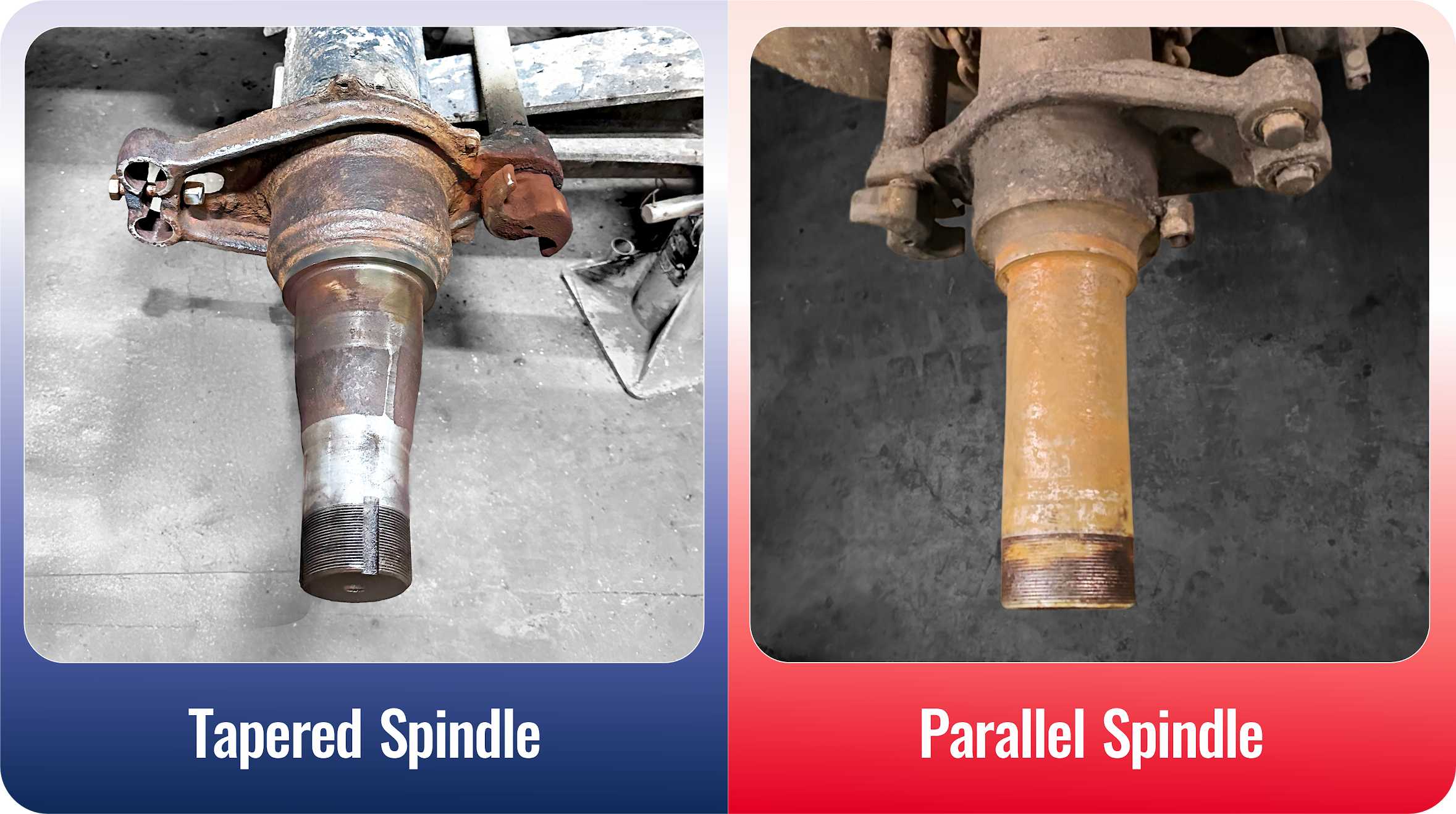
1. Parallel (Straight) Spindle
A parallel spindle uses the same bearing-journal diameter at the inner and outer positions. As a result, it uses identical inner and outer wheel bearings, providing consistent load support for the hub.
2. Tapered Spindle
A tapered spindle uses different-sized inner and outer tapered roller bearings. The larger bearing is normally positioned on the inner side of the spindle, where it carries more of the radial load.
Lift Axle Spindles (Trucks and Trailers)
Lift axle spindles are used on auxiliary axles that can be raised off the road when the vehicle is empty or lightly loaded and lowered when extra load capacity is needed. They are found on both trucks and trailers.
2. Types of Spindles Based on Design
Axle Spindle offers three spindle designs, each built to make installation and replacement easier: bolt-on spindles, spindles with a sleeve, and slip-fit spindles.
1. Bolt-On Spindles
Bolt-on spindles are designed only for drive axle applications, and not all drive axle spindles are bolt-on. They are mainly used on highway trucks and straight trucks. A bolt-on spindle is installed with bolts rather than welded directly to the axle. A sleeve is first welded onto the axle tube where the old spindle was cut off. The spindle then slips onto the sleeve, centers it, and bolts down through its flange. Because only the sleeve is welded, you can replace a worn spindle later without cutting and re-welding the tube.
2. Spindles with a Sleeve
Sleeve spindles are mostly used on semi-trailer axles. For semi-trailer spindles, you can install them in two ways, depending on the axle tube’s outer diameter (OD).
- Method 1: Axle tubes with an OD of 5″ or less
First, insert the sleeve into the inside bore of the axle tube and weld it in place. Then insert the spindle into the welded sleeve.
- Method 2: Axle tubes with an OD of 5-3/4″
The sleeve is first mounted on the rear OD end of the spindle. The sleeved spindle is then inserted into the ID bore of the axle tube.
3. Slip-Fit Spindles
Slip-fit spindles are machined to match the axle tube bore’s inside diameter (ID), making them relatively easy to install. The spindle slides into the tube and is then secured, usually by welding, depending on the axle design. This design is mostly used for light-duty to medium-duty applications, such as pickup trucks and utility trailers.
What are Spindles Made of?
Heavy-duty replacement spindles are commonly made from forged steel and may use heat-treated bearing journals for improved wear resistance.
A spindle with soft or poorly finished journals wears fast and can fail under load. This is why OEM-spec machining and heat treatment matter more than price alone.
How Do You Know If the Truck or Trailer Spindle is Worn?
A failing axle spindle rarely fails without warning; it usually shows up at the wheel end first.
| Warning Sign | Underlying Spindle Issue |
| Grease leaking from the wheel hub | The smooth surface where the rubber seal sits is scratched or worn down, letting grease escape. |
| The wheel hub is excessively hot | Bearing or spindle-journal wear is creating excessive friction and heat. |
| The wheel wobbles or feels loose | The spindle is bent or worn so much that the bearings can no longer keep the wheel straight. |
| Tires are wearing down unevenly | A bent spindle can throw the wheel out of alignment and cause uneven tire wear. |
| A loud grinding or humming noise | A failing wheel bearing may be damaging the spindle journal surface. |
| Visible scratches, dark burn marks, or cracks | The spindle has suffered heavy stress, severe overheating, or damage from a loose bearing. |
How to Check a Spindle with Our No-Go Gauge
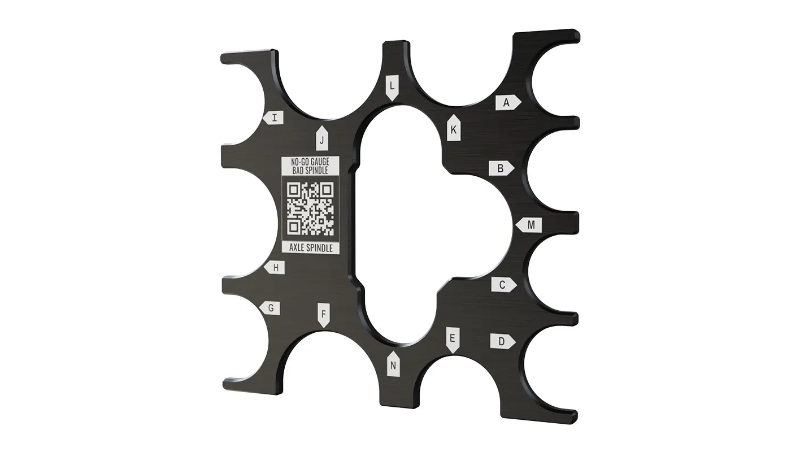
The signs mentioned above often indicate a worn or damaged spindle, but some, like heat, noise, or wobble, can also come from bad bearings. A no-go gauge confirms whether the spindle’s bearing journal is still within spec. It is a simple pass/fail tool, so you don’t need a micrometer or a spec sheet.
- Prepare the spindle: Remove the wheel, hub, and bearings, then clean the spindle so dirt and grease don’t affect the check.
- Find the Correct Slot: Enter your bearing number or ID into the No-Go Gauge Selection Wizard to find the right slot for your spindle. The gauge has 14 slots, labeled A through N, and the wizard points you to the correct one in seconds.
- Check the Spindle for Wear: With the slot selected, gently set the gauge onto the bearing journal without applying pressure. Rotate the gauge around the journal to check for localized wear, flat spots, or uneven surfaces that may not be visible from one direction. Using the right gauge slot for your spindle size is essential for an accurate inspection.
A no-go gauge checks journal wear only. If you see cracks or bending, replace the spindle without gauging it.
If you run in winter conditions, learn why wheel bearings fail in cold weather and how cold affects seals, grease, and bearing clearance.
How Do You Choose the Right Replacement Spindle for Your Truck and Trailer?
Getting the right axle spindle comes down to a few measurements and checks.
Selecting the Right Truck Spindle
- Confirm the axle configuration: Identify the axle position (front steer or rear drive). For pickups, note whether it is single rear wheel (SRW) or dual rear wheel (DRW).
- Verify product dimensions: Check the bearing journal diameters, seal surface diameter, thread size, and spindle length against the spindle’s specifications.
- Match the compatible parts: Check the compatible parts list shown with the product to make sure the bearings, seal, locknut, brake spider, and brake shoes fit the spindle you chose.
Selecting the Right Trailer Spindle
- Confirm the trailer type and axle rating: Identify whether it is a semi-trailer or a utility trailer, and note the axle rating shown on your axle tag.
- Verify the trailer spindle shape: Physically examine the bearing journals to determine whether they are the same diameter (parallel) or different sizes (tapered).
- Verify product dimensions: Check the bearing journal diameters, seal surface diameter, thread size, and spindle length against the spindle’s specifications.
- Match the compatible parts: Check the compatible parts list shown with the product to make sure the bearings, seal, and locknut fit the spindle you chose.
Axle Spindle offers a series of semi-trailer spindles to match your axle tube OD bore. Watch our video guide to learn how to select semi-trailer spindle models 75, 85, and 115.
Watch: Step-by-step choosing the right spindle and sleeve for your trailer axle.
Many similar-looking spindles are not interchangeable. If you are unsure, confirm the axle model before ordering, or contact our team for assistance.
Can a bent spindle be repaired?
Straightening a bent spindle is dangerous and never recommended. Bending can permanently weaken the metal’s structural integrity, which can lead to wheel separation. Replacing a bent spindle is the most reliable solution.
Can you replace just the spindle on a truck or trailer axle?
Yes, in most cases, you don’t have to pay the hefty cost of a full axle replacement. If your axle tube is perfectly straight, a specialist can cut away the damaged spindle section and install a precise new spindle. For accurate installation, proper alignment before welding is critical, so use the right tools or work with a recognized axle spindle facility.
How much does spindle replacement cost for trucks and trailers?
On average, truck spindle replacement costs somewhere between $900 and $2,390, while trailer spindle replacement averages $775 to $1,710. Your axle spindle replacement cost varies based on vehicle classification, labor hours, and whether secondary damage requires replacing the hub, seals, or bearings.
Looking for the Right Spindle?
Browse our truck and trailer spindle catalog, or contact our team for help finding the right part. Send us your axle model or bearing numbers, and we’ll help you find the right replacement spindle.
Final Note
Truck and trailer spindles are critical to the wheel end, so make spindle maintenance a priority. Catching early warning signs like grease leaks, hot hubs, wheel wobble, or uneven tire wear helps you prevent wheel-end failure, avoid costly repairs, and reduce downtime. Never try to straighten a bent spindle. Instead, match a new spindle to your exact axle specifications and replace it.
Share