
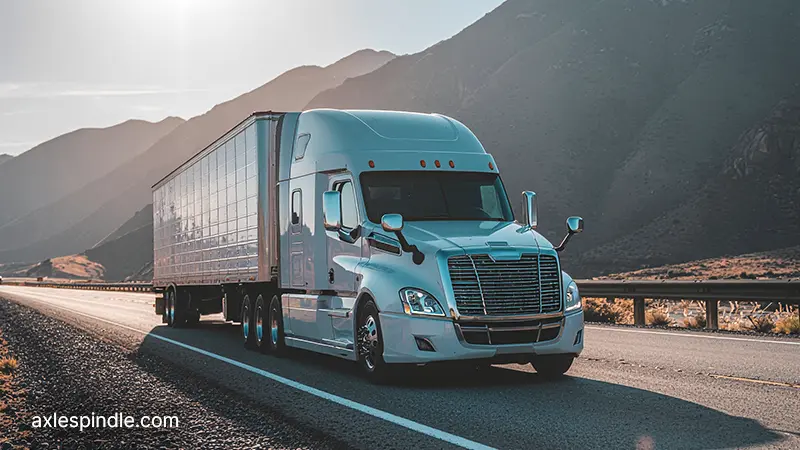
Most drivers can spot an 18-wheeler from a mile away. But ask how many axles a semi-truck actually has, and most will think twice.
A standard semi-truck runs on 3 axles: a steer axle up front, and two drive axles at the rear. Hook up a trailer, and that jumps to 5. But that’s just the starting point. Load up a heavy haul flatbed and the count climbs even higher, because every axle has one job: keep the weight legal, the load balanced, and the rig moving.
Ever been waved into a weigh station? Felt something pull in your steering? Watched a trailer tire wear unevenly on a long haul? Your axle setup is usually behind it. Get it wrong, and you are looking at overweight tickets, failed DOT inspections, and repair bills that stack up fast.
This article covers axle counts, axle types, federal weight limits, and maintenance checks to keep you legally rolling.
Before you hit the scales:
A standard semi-truck (tractor only) has 3 axles: 1 steer axle and 2 drive axles. Hook up a standard 53-foot trailer, and the total rises to 5 axles with 18 wheels across them. That 5-axle combination is legally limited to 80,000 lbs gross vehicle weight on U.S. interstates under FHWA rules.
How Many Axles Does a Semi-Truck Have
(With and Without a Trailer)
Most semi-truck drivers can feel when something is off with their axles before they ever pull into a scale. That is because each axle plays a direct role in how the truck steers, accelerates, and handles a heavy load.
How Many Axles Does a Semi-Truck Have Without a Trailer?
A semi truck on its own has 3 axles.
- 1 steer axle at the front that controls steering and helps maneuver better around 12,000 lbs.
- 2 drive axles at the rear that receive power from the engine and move the truck.
How Many Axles Does a Semi-Truck Have With a Trailer?
Hook up a standard trailer to a semi-truck, and the total goes up to 5 axles.
- The tractor keeps its original 3 axles.
- The trailer adds 2 more axles at the rear to support the cargo weight.
According to the U.S. Federal Highway Administration (FHWA), a standard 5-axle semi-truck combination is legally limited to a maximum gross vehicle weight of 80,000 lbs on the Interstate Highway System.
Why Does an 18 Wheeler Have Only 5 Axles?
The 18 wheels are simply what happens when you put dual tires on most of those axles to handle the weight safely and legally. A fully loaded semi truck and trailer combination runs on 5 axles, and those 5 axles together carry 18 wheels to keep heavy loads stable and road legal.
Because most axles carry more than 2 wheels. Here is the breakdown:
- Steer axle: 2 wheels
- 2 drive axles: 4 wheels each, so 8 total
- 2 trailer axles: 4 wheels each, so 8 total
So how many wheels does a semi-truck have? A standard 5-axle setup has 18 wheels.
2 + 8 + 8 = 18 wheels across 5 axles.
Axle Configurations by Truck Type
Not every semi-truck runs a standard 5-axle setup. Here is how axle counts vary by application:
| Truck Type | Axle Setup | Configuration | Best Use Case |
| Delivery Truck | 2 Axles | 1 steer, 1 drive | Local delivery, tight city turns. |
| Standard Semi | 3 Axles | Tandem axle (dual rear) | Routine highway freight. |
| Heavy-Duty Semi | 4 Axles | Tridem axle (triple rear) | Heavier freight, like machinery. |
| Dump / Concrete | 4+ Axles | Lift axles (drop axles) | Heavy construction materials. |
| Log / Oversized | 5+ Axles | Multi-axle groups | Extreme loads like timber or turbines. |
So, how many axles does a commercial truck have? While a standard long-haul setup typically uses 3 axles on the tractor and 2 on the trailer, the total count varies based on the load. Adding tandem or tridem axle groups allows trucks to carry heavier freight by spreading weight to meet legal limits and improve traction.
Semi-Truck Axle Types Explained
Knowing how many axles a semi truck has is just the baseline. For a fleet owner, the real strategy begins with axle configurations and legal weight limits.
Whether you’re maximizing payload, prepping for DOT inspections, or avoiding overweight fines, know your axle setup inside and out. Choosing the right axle spindle and knowing your weight limits is what separates the high-margin operators from those paying fines on the shoulder.
Below, we break down core axle types and how tandem versus spread axle setups change the game. You will learn how to distribute weight and master the Federal Bridge Formula to ensure your trucks stay legal without the cost of unnecessary hardware.
Core Working Axles on a Semi-Truck
1. Steer Axle
The steer axle is the front axle that steers the truck and determines its direction. It carries a significant portion of the truck’s weight and uses kingpins, spindles, and tie rods to keep the steering geometry on point. If the steer axle is misaligned, the truck will wander, the steering will feel loose, and you will burn through front tires quickly.
Federal Limit: 20,000 lbs federal maximum; typically 12,000-12,500 lbs in practice, limited by tire load ratings.
2. Drive Axles
Drive axles are the powered axles at the back of the tractor that put torque to the ground. They take power from the transmission to push the truck and trailer down the road. Most highway tractors are 6×4. This simply means the truck has 3 axles total, with 4 powered wheels on 2 rear axles providing the power to move the load.
Federal Limit: 20,000 lbs for a single drive; 34,000 lbs for tandem drives.
3. Trailer Axles
Trailer axles are non-powered axles that support the trailer and distribute the weight of the freight. They sit under heavy, mostly static loads for long distances. When trailer alignment or suspension parts wear out, this is usually the first place you will see uneven or patchy tire wear.
Federal Limit: Up to 34,000 lbs for a standard tandem axle group; state rules may vary.
4. Lift Axles (Auxiliary Axles)
Lift axles are extra axles that you can raise or lower depending on the weight and road conditions. You drop them to stay within axle-group and bridge-formula limits, then lift them when empty to save fuel and tire life.
Federal Limit: Varies by configuration and spacing under the Federal Bridge Formula.
- Single axle: 20,000 lbs
- Tandem axle group: 34,000 lbs
- Gross vehicle weight: 80,000 lbs
- Spread axles at 97 inches or more: In some states, you can carry up to 38,000 lbs for a 2-axle, 42,000 lbs for a 3-axle semi-truck, provided they have the correct spacing and you have the required state permits.
Lift axles support the drive axles; here’s how:
— Pusher Axle
Pusher axles are extra non-powered axles mounted in front of the drive axles. They help carry heavy loads and spread weight across more axles to meet legal limits. They can be lifted when empty to save tire wear, and some can steer to help the truck turn more easily.
Federal Limit: Regulated by the Bridge Formula based on its distance from the steer and drive axles.
— Tag Axle
These are mounted behind the drive axles. Tags are common on motorcoaches, some tankers, and heavy-haul tractors. They extend the wheelbase and increase the unit’s rear load capacity without overloading the main drives.
Federal Limit: Regulated by the Bridge Formula based on its distance from the drive axles.
Tandem Axles vs. Spread Axles
Tandem Axles
A tandem axle is any pair of axles working together as a group. The two axles are typically 40 to 96 inches apart, so they share the load and act as a heavier single axle group. This configuration boosts stability, traction, and legal weight capacity. Because the load is split between two axles, stress on tires, suspension, and frame drops, which is why tandems are common on semi‑truck drive axles and trailer axles.
Federal Limit: 34,000 lbs total for the group.
Spread Axles
Spread axles are similar to tandems, but the axles are spaced farther apart. These are often more than 96 inches apart and sometimes up to 121 inches or more. On a trailer, spread axles help you distribute the load over a longer distance to stay within bridge formula limits.
Federal Limit: Often 20,000 lbs per axle (40,000 lbs total) if the spacing is over 96 inches. Just be sure to check local regulations, as rules can vary by state.
Please Note: Federal Interstate limits per FHWA (2026) vary by state, road, permit, tire, and spec. Verify local DOT rules, weigh at scales, and consult FHWA/legal experts.
What is the Federal Bridge Formula?
Beyond individual axle weight limits, the Federal Bridge Formula controls how much weight can be carried based on the distance between axles. The farther apart the axles are, the more weight is allowed. This prevents concentrated loads from cracking bridge decks and roadbeds.
- W is the maximum load in pounds
- L is the distance in feet between the outer axles of any group
- N is the number of axles in the group.
Example:
For a 5-axle semi (N = 5) with a 51-foot spread between the outer axles (L = 51), the Bridge Formula calculates a maximum weight of 79,875 lbs. Under federal law, the Bridge Formula result (W) is rounded to the nearest 500 lbs, bringing this figure to the full 80,000 lb gross weight limit.
What are Federal Axle Weight Limits?
The FHWA sets strict axle load limits on the Interstate System to protect roads and bridges. Knowing these numbers keeps your fleet legal at the scales. Compliance with these limits prevents violations at weigh stations and supports safe fleet operations nationwide
The 3 Semi-Truck DOT Weight Limits That Keep You Legal
- Single Axle: Max 20,000 lbs for any one axle (or group spaced 40 inches or less apart).
- Tandem Axle Group: Max 34,000 lbs for two axles spaced between 40 and 96 inches.
- Total Gross Weight: Max 80,000 lbs for a standard 5-axle semi-truck and trailer.
Exceptions and State Rules
Federal weight limits apply only on Interstates. Besides that, each state enforces its own truck size and weight regulations.
- The 36-Foot Rule: You can carry 34,000 lbs on two different tandem sets (68,000 lbs total) if the distance between them is at least 36 feet.
- Grandfather Rights: 37 states and D.C. use grandfather rights, which allow them to haul higher weights on certain local routes under older state laws.
- Heavy Haul Permits: You can exceed these limits for “non-divisible” loads (like massive machinery) if you have a special state permit.
Federal limits only apply to the Interstate. Once you leave the main highway, each state makes its own rules.
For example, Michigan uses specialized multi-axle setups to allow massive gross weights up to 164,000 lbs on state routes. Whereas, Florida permits tandem axle weights up to 44,000 lbs on non-interstate state roads.
The bottom line is that being legal in one state does not mean you are legal in the next.
| Axle Type | Operation | Federal Weight Limit |
| Steer Axle | Controls direction and steering geometry using kingpins and tie rods. | Usually 12,000-12,500 lbs (limited by tire ratings) |
| Drive Axles | Powered axles that provide torque and traction to move the load. | 20,000 lbs (Single) / 34,000 lbs (Tandem) |
| Trailer Axles | Non-powered axles that support the trailer weight and freight. | 34,000 lbs (Standard Tandem) |
| Lift Axles | Lift axles raise when empty and lower when loaded to distribute weight and comply with legal limits. | Varies by configuration and spacing (20,000 lbs single / 34,000 lbs tandem) |
| Pusher Axle | Lift axle mounted in front of drives to support forward chassis weight. | Based on the Bridge Formula spacing |
| Tag Axle | Lift axle mounted behind drives to extend wheelbase and rear capacity. | Based on the Bridge Formula spacing |
| Tandem Axles | Two axles spaced 40 to 96 inches apart act as a single group. | 34,000 lbs total for the group |
| Spread Axles | Spaced 96+ inches apart to spread the load further and stay within the bridge formula limits. | 20,000 lbs per axle (40,000 lbs total) |
Why You Cannot Afford to Skip Axle Maintenance
Skipping routine checks on your steer, drive, and trailer axles is costly. It puts you at risk of Federal Bridge Formula violations, overweight fines, and breakdowns that pull your truck off the road mid-run. Catch the early signs before they catch you.
Wandering steering, drive axle grease leaks, and cupped trailer tire wear all point to alignment or spindle failure that adds up fast across thousands of miles.
Our guide on axle maintenance tips gives you the practical checks every driver should run to catch problems before they turn into downtime. Whether you drive a 3-axle or 2-axle semi-truck, seal leaks, abnormal tire wear, and vibration are never small problems. They are early warnings, and catching them before the scale house is what keeps your rig legal, your payload moving, and your axle spindle replacement costs in check.
How long is a semi truck with a 53-foot trailer?
A semi truck paired with a standard 53-foot trailer typically measures 70–75 feet total. The tractor (a sleeper cab or semi-truck) itself is about 20 to 22 feet long, and the two combined make up the longest configuration you will commonly see on the highway. This length varies depending on the tractor size or state regulations.
What is the difference between a 2-axle and a 3-axle semi-truck?
A 2-axle truck turns more tightly and is easier to maneuver in cities, tight job sites, and loading docks. It also produces less tire scrub when cornering. A 3-axle truck trades some of that agility for better stability at highway speeds under a full load, and it can legally carry more weight because the load is spread across more axles.
What are frost laws, and how do they affect semi-truck weight limits?
Frost laws are seasonal weight restrictions that run from late February through May or June in northern and Midwestern states such as Minnesota, Wisconsin, Michigan, and the Dakotas. As frozen ground thaws and road bases soften, states drop legal weight limits, sometimes from 80,000 lbs down to 60,000 lbs or lower.
Interstates are generally exempt, but any turn off the highway toward a delivery can put you on a restricted route. Violations carry per-axle fines (sometimes up to $500 per axle), out-of-service orders, and liability for road damage. Check your state DOT daily during the spring months and plan your route before you load.
Final Thoughts
Your axle setup on your tractor-trailer is one of the most important factors when hauling heavy payloads on U.S. highways. From the steer axle that guides your direction to the tandem and tridem groups that carry your payload, every component must work in harmony to meet federal weight limits and the Bridge Formula. Since weight limits vary from state to state, knowing your axle configuration is about more than federal compliance. It is about staying legal on every mile of your route. Beyond that, staying on top of axle maintenance protects your big rig from worn parts and costly repairs down the road.
Need axle spindle replacements for your semi-truck?
Browse our full range of truck spindles and trailer spindles and keep your 18-wheeler running smoothly on every mile.
Share